What Is Paddle Tennis? Rules, Court Specs, and Comparisons
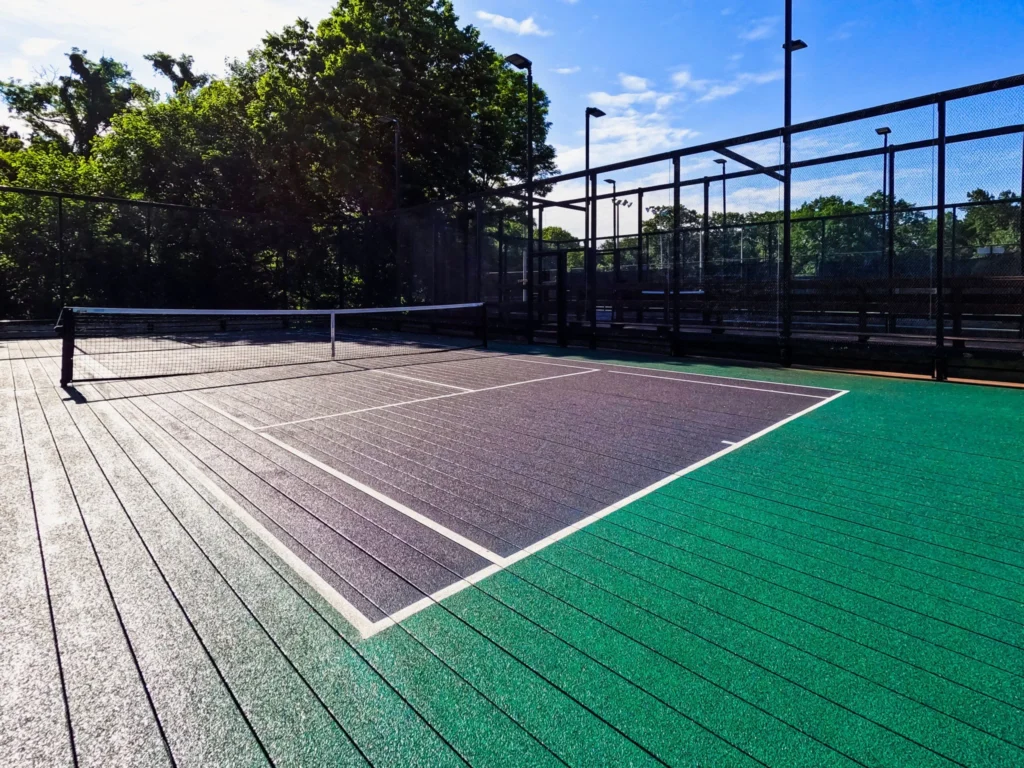
What is paddle tennis when athletes compare it to the wider world of modern racket sports? At its core, paddle tennis represents an open-court sport that evolved directly from lawn tennis. Athletes play it on a significantly smaller court using a solid, stringless paddle alongside a low-compression ball.
Consequently, the game preserves the tactical elegance, groundstrokes, and familiar scoring mechanics of lawn tennis. However, it dramatically reduces the spatial footprint and physical wear of a full-sized tennis surface. In addition, players contest matches outdoors or indoors without enclosing walls, which immediately separates the sport from cage-based games.
For athletes asking what is paddle tennis in relation to modern fitness routines, the game delivers an intense, fast-reaction workout. Furthermore, rallies last longer because lateral court positioning takes priority over full sprints. As a result, newcomers enjoy a much gentler learning curve than they encounter in lawn tennis. Because the court demands less land, it also serves as a favorite alternative for homeowners who love tennis but lack the expansive space for a standard tennis surface.
The Quick Clarification: Untangling Paddle Tennis, Padel, and Platform Tennis
Much of the confusion surrounding what is paddle tennis stems directly from regional terminology. For instance, depending on where you live in the world, different communities attach the word paddle to distinct games.
Therefore, in 2015, the United States Paddle Tennis Association officially rebranded the sport as POP Tennis. The organization introduced this change to modernize its identity and eliminate persistent confusion with European padel.
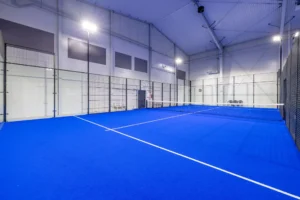
To determine which game you are watching or playing, apply these clear markers:
-
Traditional Paddle Tennis (POP Tennis): Competitors play on an open court without walls or wire screens. They hit a depressurized tennis ball over a net set at 31 inches.
-
Padel (often called padel tennis or Spanish padel tennis): Competitors play inside a fully enclosed cage featuring glass panels and wire mesh. As in squash, players routinely hit the ball off the walls.
-
Platform Tennis: Players contest this American winter sport on a raised, heated aluminum deck enclosed by taut wire screens. Consequently, competitors regularly play a dense sponge ball off the wire screens.
-
Pickleball: Athletes play on a badminton-sized court using a perforated plastic wiffle ball, a rectangular paddle, and a mandatory non-volley zone near the net.
History and Origins of Traditional Paddle Tennis
While newcomers researching what is paddle tennis often assume it began as a modern spin-off of padel or pickleball, it actually predates both by several decades.
Specifically, the Reverend Frank Peer Beale created the game in 1898 in Albion, Michigan. Beale wanted a practical recreational activity for local children that taught the fundamental strokes of tennis without requiring expensive gear or massive open fields.
Later, when Beale moved to New York City during the 1920s, he persuaded municipal officials to construct dedicated courts across public parks in Manhattan and Brooklyn. As a result, the sport expanded rapidly throughout dense urban neighborhoods. Organizers subsequently founded the United States Paddle Tennis Association and hosted the first official tournament in 1922.
Over the following decades, the game expanded westward. In particular, it developed passionate communities along coastal California. Players at Venice Beach adapted the sport into a fierce, rapid-fire competitive pastime that continues today.
Official Rules and Gameplay Mechanics
Learning the foundational rules clarifies exactly what is paddle tennis and how players execute match play. Unlike lawn tennis, which requires wider outer alleys for doubles, competitors play both singles and doubles across the exact same court boundaries.
Serving Regulations
While overhead serves dominate traditional tennis, paddle tennis strictly enforces an underhand serve:
-
First, the server must strike the ball below their waistline.
-
Next, the server drops or bounces the ball behind the baseline and drives it diagonally across the net into the opponent’s service box.
-
Finally, the server receives only one serve attempt. Because second serves do not exist, an errant serve or net fault immediately costs the server the point.
The West Coast Restraint Line
During competitive doubles play, particularly under historic West Coast rules, organizers paint an extra boundary 12 feet behind the net across both ends of the court.
Officials refer to this marking as the restraint line. Both the serving team and receiving team must keep their feet entirely behind this line until the receiver strikes the incoming serve. Therefore, this boundary stops aggressive players from charging the net too early and prevents instant, point-blank volleys.
Scoring System
The scoring structure in paddle tennis mirrors the traditional tennis framework:
-
Points steadily climb through 15, 30, 40, and Game.
-
When players tie at 40-40, they reach deuce.
-
Traditional tournaments use the standard advantage system, so a player must secure a two-point margin to win the game.
-
Alternatively, recreational leagues often utilize no-ad scoring. In this format, a single sudden-death point at deuce decides the winner, which speeds up matches significantly. Typically, teams compete across a best-of-three-set schedule.
Court Dimensions and Construction Standards
The dedicated playing court represents an essential detail when analyzing what is paddle tennis.
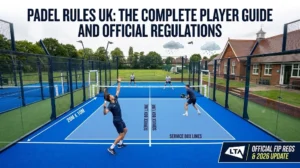
A regulation paddle tennis court measures 50 feet long between baselines and 20 feet wide from sideline to sideline. Furthermore, builders place the service lines 22 feet from the net on both sides, which positions them exactly 3 feet in front of the baseline. Consequently, this design establishes a compact service box measuring 10 feet wide by 22 feet long.
In addition, the net hangs lower than a standard tennis net. A tightly pulled steel cable suspends the net at an exact height of 31 inches across the entire playing court.
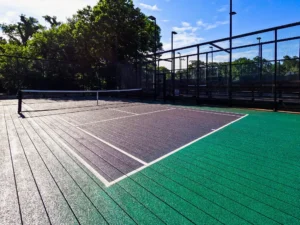
Because the perimeter spans only 50 by 20 feet, a paddle court occupies less than half the area of a regulation tennis facility. Accordingly, homeowners often install these surfaces using high-impact modular polypropylene tiles, such as SnapSports outdoor tennis court flooring, over a flat concrete base. Moreover, clubs can easily paint lines over an existing tennis court to accommodate two complete paddle tennis courts within one footprint.
Equipment Breakdown: Paddles, Balls, and Footwear
The gear in paddle tennis matches the smaller court dimensions and rapid reaction exchanges of the sport.
The Paddle
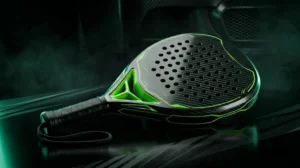
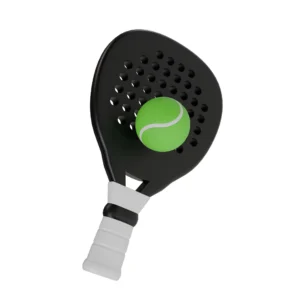
Unlike stringed tennis rackets, paddle tennis equipment utilizes a solid paddle without strings:
-
Regulation guidelines set the maximum length at 18 inches and the width at 9.5 inches.
-
Manufacturers usually construct the core with responsive EVA foam and wrap it in tough layers of fiberglass, carbon fiber, or composite graphite. Meanwhile, classic recreational models occasionally feature solid laminated wood.
-
Additionally, makers perforate the paddle face with small drilled holes to decrease air resistance, cut down swing weight, and generate aggressive spin on slices and chops.
The Ball
Standard pressurized tennis balls do not work on a 50-foot court because they bounce too high and travel too fast for consistent rallies.
Instead, the sport requires a reduced internal pressure tennis ball. Under official tournament guidelines, the ball must rebound between 31 and 33 inches when dropped from a height of 6 feet onto flat concrete.
Therefore, players regularly purchase low-compression green-dot balls, such as the Penn Control+ ball. Alternatively, some players depressurize standard tennis balls using a fine needle until the bounce matches official tolerances.
Footwear
Because the game involves constant lateral sliding and abrupt stops, athletes should never wear running shoes with tall heel cushions that invite ankle twists.
Instead, players should select dedicated hard-court tennis shoes. These designs provide durable rubber outsoles, reinforced lateral stability walls, and targeted cushioning across the forefoot.
Paddle Sports Landscape: Side-by-Side Comparison
To help athletes understand what is paddle tennis relative to other active pastimes, this breakdown compares the four major paddle sports:
| Dimension | Traditional Paddle Tennis (POP Tennis) | Padel | Pickleball | Platform Tennis |
| Court Size | 50 ft x 20 ft | 65.6 ft x 32.8 ft (20m x 10m) | 44 ft x 20 ft | 44 ft x 20 ft |
| Enclosure Walls | None (Open court) | Yes (Glass and wire mesh in play) | None (Open court) | Yes (Taut wire screens in play) |
| Paddle Type | Solid perforated composite (Max 18″) | Solid perforated composite (38mm thick) | Solid composite or wood (Rigid surface) | Solid perforated composite (Up to 18″) |
| Ball Type | Depressurized / Green-dot tennis ball | Low-pressure felt tennis ball | Perforated plastic wiffle ball | Dense sponge rubber ball |
| Serve Type | Underhand (Single serve) | Underhand (Bounce before strike) | Underhand (Volley or drop) | Overhead or underhand (Single serve) |
| Primary Region | United States | Spain, Latin America, Europe, Middle East | United States, Canada, UK | United States (Northeast/Midwest) |
Biomechanical Benefits, Tactics, and Weather Factors
A primary reason players continue adopting the sport involves its comfortable physical profile.
Because players deliver serves underhand, they avoid the extreme rotator cuff tension and lower back stress typical of overhead tennis serves. Additionally, the shorter paddle functions as a much shorter lever than a tennis racket. Therefore, it transfers significantly less torque to the wrist, elbow, and forearm, which lowers the risk of tennis elbow.
Tactically, competitors win games through clever court positioning rather than brute strength. Because players cover a smaller area, defenders easily return heavy flat shots. Consequently, winning strategies rely on floating deep lobs, dropping soft touch shots near the net, and changing angles during fast volleys.
Regarding climate conditions, open-court paddle tennis plays wonderfully on outdoor hard surfaces. However, strong winds can push the lighter, low-compression ball off line. Unlike platform tennis, which uses heated decks to melt heavy snow in winter climates, paddle tennis primarily thrives in moderate regions or within indoor recreational gyms.
FAQs
Is paddle tennis the same as padel?
No, they are distinct sports. Traditional paddle tennis takes place on an open court without walls and uses a depressurized ball. In contrast, padel occurs inside an enclosed arena where competitors bounce shots off glass and mesh walls.
Can you play paddle tennis as singles?
Yes, absolutely. Competitors play both singles and doubles on the standard 50 by 20 foot court without adjusting any boundary markings.
Why is it called POP Tennis today?
The sport rebranded to POP Tennis in 2015 to establish an unmistakable global identity, highlight the distinct popping sound of the paddle striking the ball, and end naming confusion with European padel.
What is paddle tennis scoring compared to standard tennis?
The game applies the exact same scoring progression as lawn tennis: 15, 30, 40, and Game. Players can finish games using traditional two-point deuce advantages or adopt a single-point sudden-death rule at 40-40.
Do you need special balls to play paddle tennis?
Yes, because standard pressurized tennis balls bounce too high for a 50-foot court. Players use low-compression green-dot balls or depressurized tennis balls calibrated to bounce between 31 and 33 inches from a six-foot drop.