Can You Play Padel with 2 People? Rules & 1v1 Guide
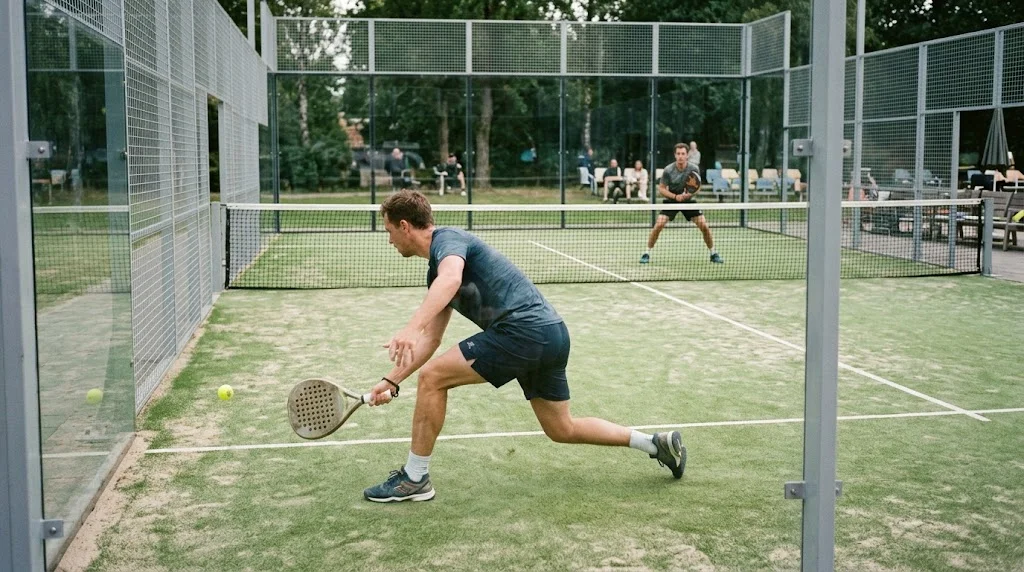
Yes, you can play padel with 2 people. While official competitive tournaments governed by the International Padel Federation require four participants, casual players can easily adapt matches for two. You can play singles on dedicated narrow courts, run full-court singles games on standard courts, or use cross-court diagonal boundaries to simulate authentic doubles rallies.
Whether your regular partners canceled at the last minute or you want an intense training session, learning how can you play padel with 2 people opens up regular court time without needing a full quartet.
Official Regulations: Is Padel Strictly Doubles?
If you consult the official International Padel Federation rulebook, the sport is defined strictly as a doubles discipline. Every major professional tour, from Premier Padel to national championships, features pairs competing against pairs.
The sport was engineered around teamwork, angles, and spatial puzzle-solving. The presence of enclosing glass walls and metal mesh turns the 20-meter by 10-meter surface into a tactical landscape where controlling the net as a unit is the primary objective.
However, recreational clubs operate under practical realities. Court availability, varying schedules, and personal training goals frequently lead players to ask: can you play padel with 2 people when you cannot assemble four players? The answer is an enthusiastic yes, provided you understand how the mechanics shift once two bodies leave the turf.
Three Formats for Playing Padel with Two Players
Stepping onto the turf with only one friend across the net requires choosing a format that matches your goals. There are three primary ways to approach a two-player session.
1. Cross-Court Diagonal Play (The Best Tactical Option)
Cross-court play, often called diagonal padel, is the gold standard for two players sharing a standard court. In this setup, both players restrict their play strictly to diagonal halves. For example, the server on the deuce side plays exclusively into the receiver’s deuce side.
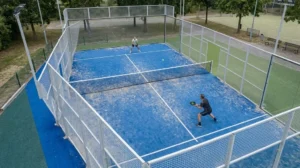
If a shot lands on the opposite side of the court, it is deemed out of bounds. This setup mirrors the exact tactical angles found in competitive doubles. You execute backhand drops, lobs over the right shoulder, and wall defense just as you would during a sanctioned match. For serious enthusiasts asking how can you play padel with 2 people to sharpen technique, diagonal play is the premier choice.
2. Full-Court 1v1 on a Standard Court (The Cardio Test)
If your objective is pure endurance and cardiovascular conditioning, you can open up the entire 20-meter by 10-meter area. Each player defends a full ten-meter baseline alone.
While entertaining, this format changes the sport significantly. Covering ten meters of baseline width on a bouncy surface requires relentless sprinting. More importantly, rushing the net becomes risky because a single player cannot protect both the down-the-line pass and the cross-court lob. If you try this variant, approach it as an intense workout rather than a technical clinic.
3. Dedicated Singles Padel Courts (Purpose-Built 1v1)
As the sport expands worldwide, modern clubs increasingly install purpose-built singles courts. These facilities remove the guesswork for players wondering can you play padel with 2 people under official-feeling conditions.
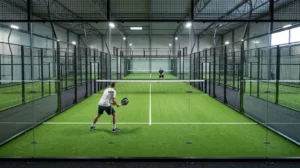
A dedicated singles court preserves the traditional 20-meter length but reduces the width from 10 meters down to 6 meters. This altered geometry restores balanced court coverage. One person can capably guard the net, close off passing lanes, and execute classic defensive wall rebounds without covering excessive open space.
Court Dimensions Compared: Standard vs. Singles
Understanding court proportions helps explain why 1v1 formats feel so different from standard play.
-
Standard Padel Court: 20 meters long by 10 meters wide. Designed specifically for four players, offering 200 square meters of total area, or 50 square meters of defensive responsibility per athlete.
-
Dedicated Singles Court: 20 meters long by 6 meters wide. Designed for two players, offering 120 square meters of total area, or 60 square meters of responsibility per athlete.
When attempting full-court 1v1 on a standard setup, each player must defend 100 square meters, doubling the physical workload of doubles. By contrast, a dedicated singles court closely matches the personal coverage area of a standard doubles game.
Rule Adaptations and Scoring for 1v1 Matches
Adapting standard padel rules for two participants requires minor adjustments, particularly around the serve and boundary tracking.
Serving Protocols
When playing cross-court, the serve follows standard rules: underarm, struck below waist level after a single bounce, directed diagonally into the opposing service box. The difference arises on subsequent points.
Instead of switching sides after every point as in traditional doubles, diagonal players typically complete entire games on one diagonal side before switching to the opposite diagonal for the following game. Alternatively, you can use the Australian formation where you swap receiving boxes every point, though this requires constant repositioning.
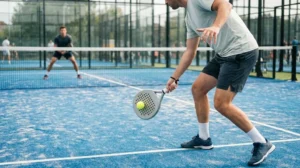
When playing on a dedicated singles court or full-court 1v1, standard tennis-style service rotations apply. You start from the right side, serve diagonally, and alternate service boxes after every point scored.
Scoring Structure
Traditional scoring remains identical. Points progress through 15, 30, 40, and game. You can utilize conventional advantage scoring or adopt the golden point (punto de oro) system to keep the pace brisk. Tiebreakers follow standard sets, first to seven points with a two-point margin.
Wall Rebounds and Out-of-Bounds Calls
All traditional ball interactions remain intact. The ball must strike the turf once before rebounding off the rear glass or side walls. When evaluating can you play padel with 2 people during diagonal matches, the only custom rule is honoring the imaginary center boundary line. Any ball landing across the center line onto the unused parallel half results in an immediate loss of point.
Does 2-Player Padel Help or Hurt Your Doubles Game?
Engaging in two-player padel offers distinct advantages alongside a few technical habits to monitor closely.
The Clear Advantages
-
High Repetition Volume: In traditional doubles, your partner claims half of all incoming shots. In 1v1 or diagonal play, you contact the ball on every return, doubling your touch volume within the same court hour.
-
Sharpened Wall Defense: Diagonal rallies force constant exposure to double-glass corners and tricky side-wall spins, accelerating your defensive reading skills.
-
Conditioning and Footwork: Navigating court movements solo rapidly improves split-step cadence and baseline recovery speed.
Habits to Watch Out For
-
Middle-Court Neglect: Doubles success relies heavily on communication regarding who takes the middle ball. Playing solo eliminates partner coordination.
-
Unrealistic Positioning: If you play full-court singles on a standard padel layout, you may develop a habit of camping deep behind the baseline, which contradicts proper doubles positioning where taking the net controls the point.
Ultimately, knowing can you play padel with 2 people productively comes down to format choice. Using diagonal constraints reinforces doubles instincts, while open-court singles prioritizes pure physical conditioning.
FAQs
Can you book a standard padel court for 2 people?
Yes. Padel clubs rent the court by the hour, not by the number of participants. You can book a standard court and play 1v1 singles or cross-court drills without issue.
Is padel harder with 2 players than 4 players?
Playing full-court 1v1 is significantly more demanding physically because one person must cover the territory normally handled by two. However, cross-court diagonal play maintains a manageable physical rhythm comparable to standard doubles.
Why do some people say can you play padel with 2 people only for practice?
Because official tournaments do not recognize singles play on standard courts, many purists view two-player sessions primarily as training drills. Nevertheless, casual 1v1 matches remain a popular, high-energy way to enjoy the sport.
How wide is a singles padel court compared to a normal court?
A singles court is 6 meters wide, which is 4 meters narrower than a standard 10-meter doubles court. Both share an identical length of 20 meters.
Can you play padel with 2 people if you are complete beginners?
Yes. Beginners often benefit from two-player sessions because the lack of rotational complexity lets them focus entirely on contact timing, basic wall rebounds, and ball control.