Padel Rules UK: The Complete 2026 Player Guide
Padel currently ranks as the fastest-growing sport across Britain. Private clubs and leisure centres from London to Edinburgh now build courts to meet massive player demand. The game blends elements of tennis and squash. Rallies move quickly, yet beginners find the fundamental mechanics remarkably easy to learn. Whether you want to try a social mix-in or enter your first competitive event, clear knowledge of padel rules uk will give you immediate confidence. This guide breaks down the official regulations step by step so you can avoid costly errors and win more points.
The Core Basics: What Is Padel and How Does It Work?
Padel operates almost universally as a doubles sport. Four players share the court during official matches. While coaches sometimes use purpose-built single courts for solo training drills, clubs run all competitive matches in a two-versus-two format.
The Lawn Tennis Association (LTA) governs the sport across Great Britain. The LTA follows all standards that the International Padel Federation (FIP) publishes.
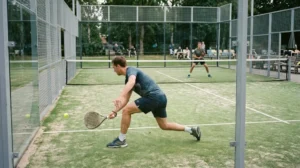
Racket sports players find the setup instantly familiar. However, the enclosed court completely transforms match tactics. The core playing rules require players to hit underarm serves, respect ground bounce limits, and use the rear glass walls to build counterattacks.
Court Architecture and Boundaries: Dimensions in Meters
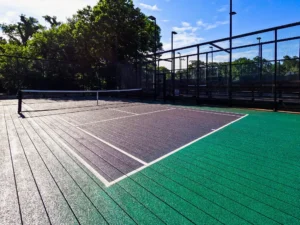
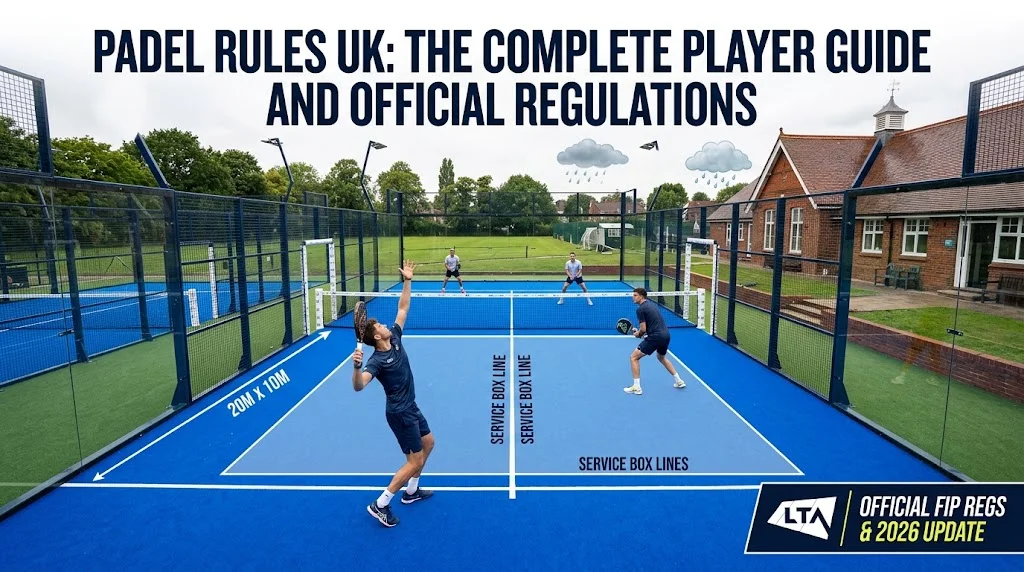
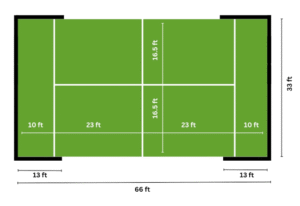
A regulation padel court measures 20 meters long and 10 meters wide. A central net splits the court evenly. The net measures 88 centimeters high at the center and rises to 92 centimeters at the posts.
Wall Materials and Enclosure Heights
A protective cage of reinforced glass panels and steel mesh surrounds the playing surface. The rear walls reach 4 meters in height. Toughened safety glass forms the lower 3 meters, while wire mesh covers the top meter. The side walls feature a stepped combination of glass panels and steel mesh fencing to challenge shot angles.
How Court Markings Function During Play
Tennis relies on painted lines to mark court boundaries throughout every rally. In contrast, padel lines only matter when a player serves. The service lines sit parallel to the net at a distance of 6.95 meters. A center line splits this space into two equal service boxes.
Once the receiving team returns the serve, baseline and sideline markings serve no further purpose. The surrounding walls take over as the true physical boundaries of the court.
Padel Serving Rules: Mechanics, Heights, and Legal Contact
New players often commit their most frequent mistakes during the serve. Tennis converts usually attempt overhead serves out of habit. Padel strictly forbids overarm serves at all skill levels. Every player must deliver an underarm serve to start the rally fairly.
Step-by-Step Legal Service Execution
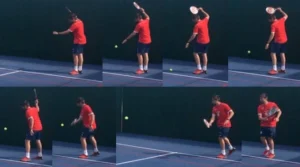
You must follow five core requirements to execute a valid serve:
-
Positioning: Stand completely behind the service line between the center mark and the side wall. Keep both feet behind the line until your racket strikes the ball. Stepping onto the painted line triggers an immediate foot fault.
-
The Ground Bounce: Drop the ball and let it bounce on the turf behind the service line. You cannot strike the ball out of the air.
-
Waist Height Limit: Strike the ball at or below your waist level. Hitting above your natural hip line results in an invalid attempt.
-
Target Box: Drive the ball diagonally across the net into the opposite service box.
-
Two Serves: You receive two serve attempts on every point. If you miss both tries, your opponents claim the point.
Fence Violations and the 2026 Serving Update
The fence rule causes frequent debate during club games under padel rules uk. If your serve bounces in the target box and hits the glass, play continues normally. However, if the ball bounces in the box and clips the metal wire fence, the serve counts as an instant fault.
The 2026 FIP serve update bans forward tosses across court markings. Servers cannot toss the ball across the service line or center line before making contact. The ball must stay behind the line until your racket strikes it cleanly.
The Wall and Enclosure Rulebook: Glass Panels vs Metal Mesh
The surrounding walls give the sport its fast, dynamic character. Learning how to read rebounds quickly separates advanced players from newcomers.
Rebounds on the Opponent Side
Your shot must hit the turf on the opponent side before it touches the glass or fence. If you hit the ball directly into their back glass on the fly, you lose the point. If the ball bounces once on the turf and strikes their glass, the rally continues.
Defending with Your Own Glass
You can hit the ball firmly against your own rear glass wall to return it over the net. This defensive escape helps you survive difficult corner attacks. However, you must never hit the ball into your own metal mesh. Striking your own fence forfeits the point instantly.

Running Outside the Enclosure
Many modern UK venues build courts with extra safety run-off space outside the doors. When a court provides this clearance, players can run through the door to retrieve an opponent smash. You must strike the ball back into their court before it bounces twice on the exterior ground.
Match Scoring Systems: From Tennis Sets to Sudden Death
Padel matches follow traditional scoring increments:
-
Game points: Love (0), 15, 30, 40, and Game.
-
Sets: The first pair to win six games with a two-game margin takes the set.
-
Tie-break: At 6-6 in games, players contest a 7-point tie-break. You need a two-point margin to win.
-
Matches: Official tournaments usually schedule best-of-three-set matches. Many local UK events replace the third set with a 10-point super tiebreak to save court time.
Golden Point vs Advantage Scoring in UK Clubs
Standard rules require teams to win two straight points from 40-40 to secure a game. However, recreational leagues operating under padel rules uk often adopt the Golden Point format.
At 40-40, teams play a single sudden-death rally. The receiving team selects which partner receives the decisive serve. This format speeds up matches and adds great excitement. Higher-grade LTA tournaments may also use the 2026 Star Point rule. This hybrid system requires two normal advantage attempts before triggering a sudden-death point on the third deuce.
Alternative UK Social Formats: Americano, Mexicano, and King of the Court
British clubs run popular social mix-in tournaments alongside standard match play.
| Tournament Format | Match Rules | Scoring System |
| Americano | You enter as a solo player. The event software assigns you a fresh partner and two new opponents every round. | Rounds finish when teams reach a target point score, usually 24 or 32 points. Organizers log every individual point on a master table. |
| Mexicano | Similar to Americano, but software organizes subsequent matches using live leaderboard results. Top performers compete directly against each other. | Players accumulate total points across several quick rounds to find the overall champion. |
| King of the Court | Pairs play short, timed mini-matches. Winning teams climb up to the premier court, while losing pairs drop down. | A central timer governs play, which encourages fast-paced points and constant court rotations. |
Instant Point Losers: Common Padel Faults and Net Infringements
Certain actions forfeit the rally immediately, no matter how well you hit the ball.
Net Violations and Reaching Across
Touching the net fabric, center strap, or support posts with your body or racket loses the rally instantly. In addition, you cannot reach across the net to hit a ball on the opponent side.
You can only cross the net plane on your natural follow-through after striking the ball on your side. The only exception happens when an opponent smash bounces off your back glass and spins back over the net. In that single scenario, you can reach over to tap the ball before it lands.
Double Bounces and Unlawful Ball Deflections
You must return the ball before it bounces twice on your court surface. Letting the ball hit the turf a second time loses the point.
Furthermore, double hits made with two distinct swings violate the rules. If the ball touches your shirt, shorts, or shoes during play, your opponents collect the point immediately.
UK Weather Adaptations and Court Obstacles
Outdoor matches in the UK face unique climate challenges that impact gameplay.
Playing with Moisture on Outdoor Glass
British rain creates sudden moisture on outdoor glass panels. When a felt padel ball strikes damp glass, it skids downward and drops like a stone instead of bouncing upward. Official padel rules uk permit outdoor play during light drizzle unless standing water creates slipping hazards. Smart players adjust by hitting defensive shots earlier before the ball reaches wet walls.
Dealing with Low Indoor Beams and Roof Lights
Many British operators convert industrial warehouses into indoor padel centres. If a ball hits a roof beam, overhead cable, or lighting fixture, the ball goes dead immediately.
If you hit a ball into a roof beam on the full, you lose the rally. Conversely, if your smash bounces on the opponent turf and then strikes an overhead beam, you win the point.
Equipment Regulations: Rackets, Leashes, and Ball Pressure
Official padel rules uk enforce strict equipment standards to ensure safety and fair competition.
Racket Standards and Wrist Cord Safety
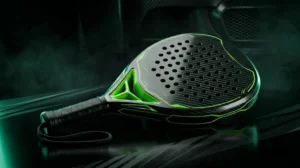
A standard padel racket features a solid composite hitting surface perforated with aerodynamic holes. Official rules restrict racket dimensions to 45.5 centimeters in length, 26 centimeters in width, and 38 millimeters in thickness.
Every racket must include a built-in safety cord on the bottom of the handle. You must secure this strap around your wrist before starting any point. If you drop your racket during play, the umpire awards the rally to your opponents immediately.
Padel Balls vs Tennis Balls
Padel balls look nearly identical to regular tennis balls, but their internal pressure differs significantly. Padel balls use lower pressure ratings, typically measuring between 10 and 12 psi compared to 14 psi in tennis.
Lower pressure controls the rebound speed off the glass and protects player joints. The LTA forbids tennis balls in sanctioned padel competitions because higher bounce speeds disrupt fair play. In addition, clubs require herringbone court shoes to protect sand-dressed artificial turf.
Padel Rules vs Tennis: Direct Comparison
Tennis players adapting to padel can quickly reference the structural differences between both sports below.
| Rule Category | Padel Regulations | Tennis Regulations |
| Match Format | Exclusively doubles across competitive events | Both singles and doubles options |
| Court Dimensions | 20m x 10m fully enclosed court | 23.77m x 10.97m open court |
| Serve Delivery | Underhand only, below waist, after a bounce | Overhead permitted directly from the air |
| Enclosure Walls | Perimeter glass and mesh active during rallies | No walls; stray balls leave the court |
| Court Lines | Lines only apply during the serve | Lines dictate boundaries on every single shot |
| Volleys | Allowed at all times except returning serve | Permitted on all shots, including service return |
| Deuce Resolution | Advantage play or sudden-death Golden Point | Standard two-point advantage required |
FAQs
Can the ball hit the wire fence on a serve?
No, the ball cannot hit the fence on a serve. While hitting the glass after bouncing in the target box remains completely legal, striking the wire mesh fence constitutes an immediate service fault under padel rules uk.
What happens if you touch the net with your racket?
Touching the net or support posts with your racket, clothing, or body results in an immediate loss of the point.
Can you hit the ball off your own glass wall?
Yes, you can hit the ball into your own glass wall to pass it over the net. However, you can never play the ball off your own wire mesh fence.
Is padel always played as doubles in the UK?
Yes, standard tournament matches and club social leagues operate strictly as doubles games under official padel rules uk. Venues only use singles courts for personal coaching and fitness training.
Who makes line calls during un-umpired club matches?
Players make line calls on their own side of the court during self-officiated club fixtures. When partners disagree or cannot see a mark clearly, standard sports etiquette encourages a friendly replay of the point.
Learning the key guidelines behind padel rules uk will improve your match strategy, reduce arguments, and help your team win crucial points. Keep your serve below waist level, track your wall rebounds, and enjoy playing this exciting sport.